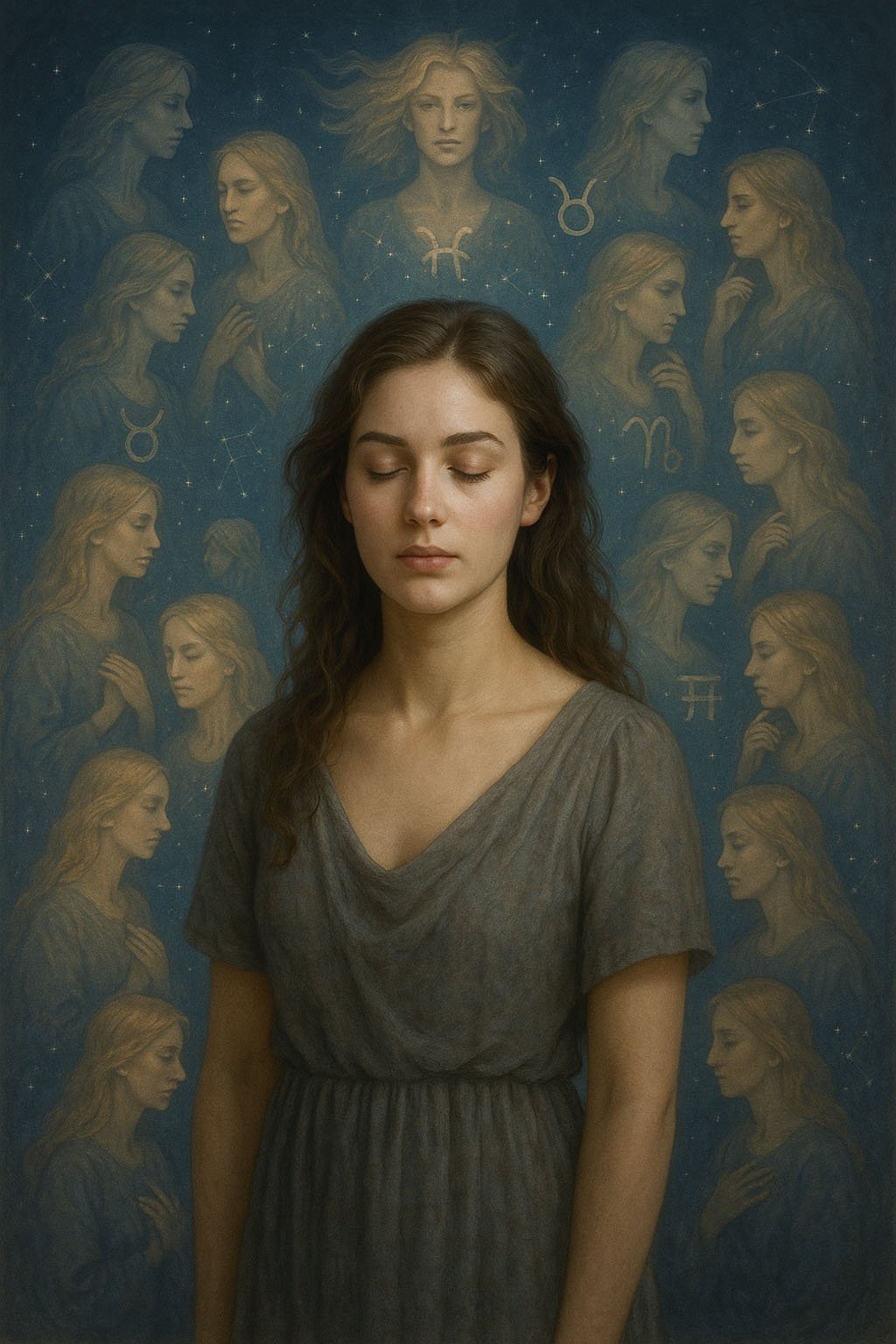
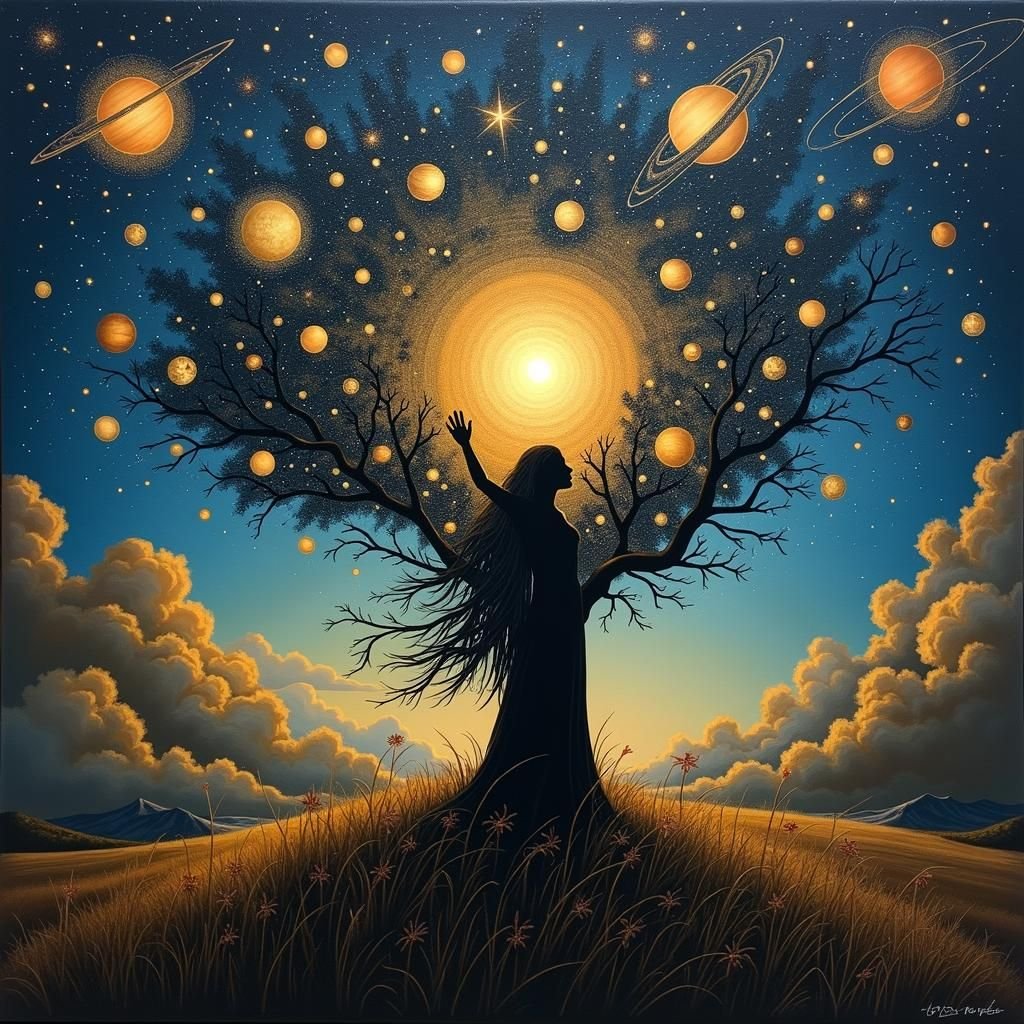
Have you ever wondered why astrology resonates with you, without locking you into fixed scenarios? Perhaps you’ve heard that astrology inevitably predicts what’s in store for you, like a prophecy drawn in the stars. However. Astrology is not an oracle that dictates your future; it’s a poetic mirror that reflects your innermost essence. It doesn’t predict. It reveals.
Astrology as a symbolic mirror
Imagine standing under the night sky, watching the twinkling constellations. In these celestial spaces, you see more than just stars. You feel a call, an invitation to turn your gaze towards your inner universe. This is where astrology comes in: it weaves a subtle link between the cosmic infinite and the human heart. Every planet, every sign, every house is a symbol whispering hidden truths to anyone who will listen.
Some people regard astrology as a set of predictions, hoping to find concrete answers. Yet astrology functions more like a symbolic mirror than a crystal ball. The stars don’t impose a destiny on you; they reveal potential. They highlight your shadows and your strengths, your creative impulses and your points of vulnerability. Just as when you look into clear water, you see your reflection with clarity, but this reflection is not the person himself, only the image he projects.
In this approach, astrology lies between the poetry of the heavens and the psychology of the self, between cosmic dance and introspection. You’ll discover a language capable of naming your fears, calming your doubts and celebrating your desires. That’s why, at Astrara, we prefer to speak of guidance rather than prediction, of expansion rather than fate. For while the movements of the planets indicate cycles, they do not condemn. They illustrate, illuminate and invite, like a lighthouse guiding your own boat towards the shore of awakening.
The natal chart as a tool for revelation
At the heart of astrology lies an invaluable tool: the natal chart. Drawn from your date, time and place of birth, it’s a celestial map representing the position of the stars at the exact moment you took your first breath. Like a cosmic mandala, it symbolizes the different parts of your being. It is neither an imposed roadmap, nor a trap on which is written “this is your destiny”. Quite the contrary. The natal chart acts as a table of harmony, or sometimes dissonance, indicating the colors that make up your inner palette.
When you explore your chart, you’ll discover its incredible richness: planetary aspects revealing your communication and love patterns, the Moon’s particular position underlining your emotional needs, or astrological houses describing the areas of life that demand your attention. These elements are not fixed; you have the free will to play each note at your own tempo.
Think of your natal chart as a manuscript offered by the cosmos, a framework to be completed as your life unfolds. It reveals your inclinations, but remains sensitive to your actions, choices and transformations. Each planet, each sign, draws a part of your canvas. You alone decide the final nuance. In this way, astrology becomes a path to your inner self, not a barrier to the future.
Planets as living archetypes
In astrology, planets are not mere spheres wandering in the void of space; they are living archetypes that tell stories. They illustrate psychological forces, creative or restrictive energies, which interweave and respond to each other in our daily experiences.
The Moon, for example, is the guardian of your inner world. It protects your moods and emotional rhythms. Sometimes inspired, sometimes unstable, it reflects the poetry of water rising and receding, linking you and the ocean in a vast, sensitive ballet. Far from predicting drama, the Moon highlights the nuances of your affections, portraying your home, your maternal energy and your need for security.
Venus is a celestial singer who celebrates love, beauty and pleasure. She invites you to aestheticism, sensuality and self-discovery through tenderness. Venus whispers to you: “Don’t forget to love and let yourself be loved, don’t forget to honor the poetry hidden in your everyday life.” Instead of a fatalistic forecast, she shows you how you can flourish in your relationships and creativity.
Saturn, often feared, is the sage who teaches you about limits, responsibilities and the depth of time. Rather than heralding inevitable trials, it reveals your potential for maturation. It sparks your ambition and pushes you to define your foundations. With Saturn, you actualize your potential by facing challenges that make you stronger. In the end, it’s not the planet that imprisons you, but your own fear of growing up.
Through these archetypes, you learn to recognize your own rhythms. You see that your heart beats in resonance with the galactic immensity, but you are never trapped in an immutable trajectory. The planets are symbols, paintings from the cosmic palette that imprint unique colors on you. It’s up to you to arrange them, to savor them, to transcend them.
Conclusion: astrology accompanies inner transformation
When you realize that astrology doesn’t predict. It reveals. You open the door to a form of inner wisdom. Instead of looking to the stars for a verdict on your destiny, you find an echo of your own questions, a reflection of your potential, a map of your soul. With each lunar cycle, with each transit of Venus, you progress on an evolutionary journey of your own. You are the artist who traces contours, colors shadows and illuminates your aspirations.
At Astrara, we encourage a poetic and caring approach to astrology, where each symbol is approached as a guide to greater authenticity. After all, it’s not a closed destiny that awaits you. It’s a vast field of possibilities, a stellar ocean inviting you to explore. Awakened astrology is an act of self-love. An invitation to look at yourself with gentleness, to celebrate the impulses of your heart as much as the silences of your soul. Only you hold the key to your future. The stars merely hold up a mirror to light the way.
FAQ , Understanding astrology beyond prediction
1. Can astrology really predict the future?
You’ve probably already read an astrological column announcing, perhaps, a great upheaval to come or a decisive encounter. But if you examined it carefully. You’ll have noticed that the predictions are vague and generalized. In a deeper vision, astrology doesn’t limit itself to spelling out future events. Rather, it brings to light the dynamics that are interwoven within you. So you’re free to express them in different ways. Like the dew that shines in the morning, astrology reveals what already exists within you, not a future written in stone.
2. How does astrology help us to know ourselves better?
Astrology takes a gentle plunge into your inner world. Through the exploration of your natal chart, you discover how you interact with love, communication or emotional management. You recognize your needs, your deepest challenges and the way you live your relationships. This is not prophecy, it’s perspective. When you become aware of your inner “map”, you can act more lucidly, more creatively and, above all, more respectfully of your authentic aspirations.
3. Do planetary energies impose an irremediable karmic destiny?
It’s common to fear a karmic chain of events dictated by the planets. But this is not the case. Instead, astrology invites you to engage in a dialogue with yourself. The stars symbolize different interacting forces. You have free will. You can deal with these influences by being attentive to the messages they convey. For example, if Saturn points to a need for structure and responsibility, you can choose to ignore this reminder or, on the contrary, welcome it to lay more solid foundations for your projects. Astrologically, it’s your attention, your awareness, that makes the difference.
4. Why are the planets referred to as archetypes?
The planets, if we look at them closely, represent universal narratives, energies found in many mythologies. Each embodies a dimension of the human psyche. Mars, for example, speaks of courage and action. Jupiter evokes expansion and optimism. These archetypes help us decipher your tendencies and impulses. They are not a celestial mandate, but offer a symbolic vocabulary for understanding what’s going on inside you.
5. How can astrology be integrated into a personal development program?
Astrology can act as a companion on your journey, a sacred but non-religious tool you can use to nurture your evolution. You can, for example, compare your awakenings to lunar cycles, where each New Moon suggests an emotional renewal and each Full Moon illuminates your successes and resistances. By keeping a journal, you weave a link between your thoughts, your sensations and the cosmic movements around you. You’re not looking for a blind belief. You’re looking for a mirror, a story that the sky whispers to you, so that you can dive deep inside yourself. At Astrara, we offer guidance focused on these key moments, when the light of the stars becomes a source of introspection.
6. Is astrology for everyone?
Absolutely. Astrology invites you to explore, without the need for a cult or ideology. You can benefit from it if you consider yourself rational, just as if you have a penchant for poetic spirituality. Basically, it’s for anyone who feels the need to understand themselves better, to harmonize with their inner world and celebrate their uniqueness. Quite simply, it’s a language that links earthly life to our quest for meaning. No one is forced to conform to it, just as no one is forced to love poetry. But for those who resonate with it, it’s a doorway to multidimensional self-knowledge.
7. How can we protect ourselves from an overly deterministic use of astrology?
Some simplistic or overly rigid interpretations can turn astrology into a straitjacket. The important thing is to remain open-minded. Remember that a symbol is above all a meeting place between the imaginary and reality. Think of astrology as music that inspires you, but never replaces your free will. If you feel that predictions are clouding your horizon, turn to a more nuanced, freer vision, more respectful of your infinite potential.
Ultimately, astrology is a reflection, not a condemnation. It illuminates what’s going on inside you, just as the flame of a candle reveals the shape of the shadows on the wall. By seeing it as a tool of revelation rather than an immutable oracle, you give yourself the opportunity to grow, to love and to transfigure your trials into opportunities for beauty. That’s why, at Astrara, we invite you to embrace the poetic dimension of astrology, to encounter your many inner aspects with gentleness, and to let yourself be guided by your intuition, rather than your fear.
1 “Astrology is a science in itself and contains a body of knowledge that lights the way.” – Albert Einstein
2. “Astrology doesn’t tell us what’s going to happen, it tells us where we are.” – Susan Miller
3. “Astrology is a dance between you and the universe. It doesn’t tell you what you are, it shows you how you can be.” – Steven Forrest
Recommended books
1 “Astrology for the Soul”by Jan Spiller: This book explores the spiritual dimension of astrology, presenting how the lunar nodes can reveal the path of the soul. Jan Spiller guides the reader through deep introspection, highlighting the karmic lessons and gifts of each sign, while encouraging harmonious personal growth.
2. “The Inner Sky”by Steven Forrest: Forrest depicts astrology as a narrative and psychological art. Through stories and examples, he shows how each sign and planet represents a part of our psyche, helping readers understand and celebrate their own complexities.
3. “Astrology: A Cosmic Science” by Isabel Hickey: A classic that presents astrology as a tool for self-understanding. Hickey explains how planetary movements do not determine our destiny, but reveal the energies we can work with for our personal evolution.
4. “The Twelve Houses” by Howard Sasportas: This book offers an exploration of the astrological houses, seen as the fields of human experience. Sasportas describes how each house reveals aspects of our lives, from our careers to our relationships, inviting enriching introspection.
5. “Planets in Transit”by Robert Hand: A detailed guide to planetary transits, this book shows how planetary movements can illuminate the cycles of our lives. Hand explains that transits indicate moments of potential transformation, rather than predestined events, paving the way for deep self-reflection and personal empowerment.